Wednesday, August 7, 2019

BBC No Deal Prepping

Visiting the BBC News site today I saw the "no deal" Brexit feature pieces. I didn't really bother reading them (as you can see from the image below I only even clicked on the first one). Again, as I've mentioned before I'm starting to get bored with reading and talking about it all. I feel we've had the same circular arguments about the dangers of "no deal" for three full years now.

(BBC "no deal" Brexit features)

Anyway, my reason for highlighting these articles is that they seem to strike a more practical tone. Informing people, in a reasonably balanced way, about the practical consequences of a "no deal". Prepping people in a sense, rather than just pushing a political angle. This makes me think that perhaps a "no deal" (do I have to keep putting quotation marks around that?) is looking more likely. In fact, the first article with the fruit and veg imagery is almost identical to an article the BBC published earlier in the year when no deal was looking quite likely then.

On a side note I actually think the BBC has became more balanced on this over the last year or so. It's easy to bash the media, and I've done it a fair bit over the last few years, however you also have to give credit too. For all the supposed division in the country I actually feel like Britain is collectively finding common ground. Sure, the hard remain and hard leave arguments aren't going to disappear anytime soon, but I do think people are increasingly beginning to understand the feelings of people on the opposing side of the argument.

In fact, my main worry remains the EU. I still don't see any sign that they're prepared to change tack. To stop seeing Brexit as an enemy that needs to be defeated, and to start seeing it as simply people on one part of the continent choosing a slightly different path.

In Britain we quite like a good argument. It seems to be our default setting. There are problems with this of course, but one of the great benefits is that the political and social landscape evolves pretty quickly. If someone has a problem with something you get told fairly fast and have no choice but to confront it, with politeness taking a backseat if necessary. It's not even considered impolite to shout and argue in our parliament, which I personally think is great (we're quite a rowdy bunch). It is however something that isn't to everyone's taste, and that's perfectly understandable.

On the continent, particularly within the EU, it seems they much prefer consensus. Again, that way of doing things can have huge benefits, but it does mean that problems sometimes get hidden under the carpet. Then when they do rear their head the arguing and criticism feels all the more stinging, as people just aren't used to being presented with such intransigence. Watching all the various Brexit documentaries I often get a sense that the EU politicians take the criticism a lot more personally than we do. I'm sure this is a cultural thing. I just don't think they're used to being verbally attacked in this way, they have a different way of operating. Whereas for us it's just normal political life.

I always get the same feeling whenever I see Nigel Farage give a tirade in the EU parliament. I feel like tweeting to the EU politicians "Don't worry, this is normal for us, this is how we speak to each other. We don't just speak to you guys like this."

Perhaps there just is a fundamental cultural difference though. The EU like their long term, set in stone plans, we like our more flexible, constant chatter approach. So maybe it's better we head down different paths. This doesn't mean there has to be any enmity though. In fact, it could be great for both sides.

Tuesday, August 6, 2019

Brexit Party Transgender Candidate

The Brexit Party have announced some more of their candidates. The big news seems to be that one is seeking to be the UK's first transgender MP. My first impression is that this seems like tokenism. A kind of "look, we're not bigoted, we're the first party to attempt to get a trans person elected" type thing.

Obviously the transgender issue is quite a controversial one too, so it's something that will generate a lot of content on social media. No doubt in the mainstream media too, though it'll be difficult for news outlets on either side to know how to play this one. Will "the right" take to heart a transgender politician and the accompanying trans rights activism? Will "the left" be able to stomach giving credit to the Brexit Party for being progressive? They've certainly been reluctant to credit them for their gay and ethnic MEPs so far.

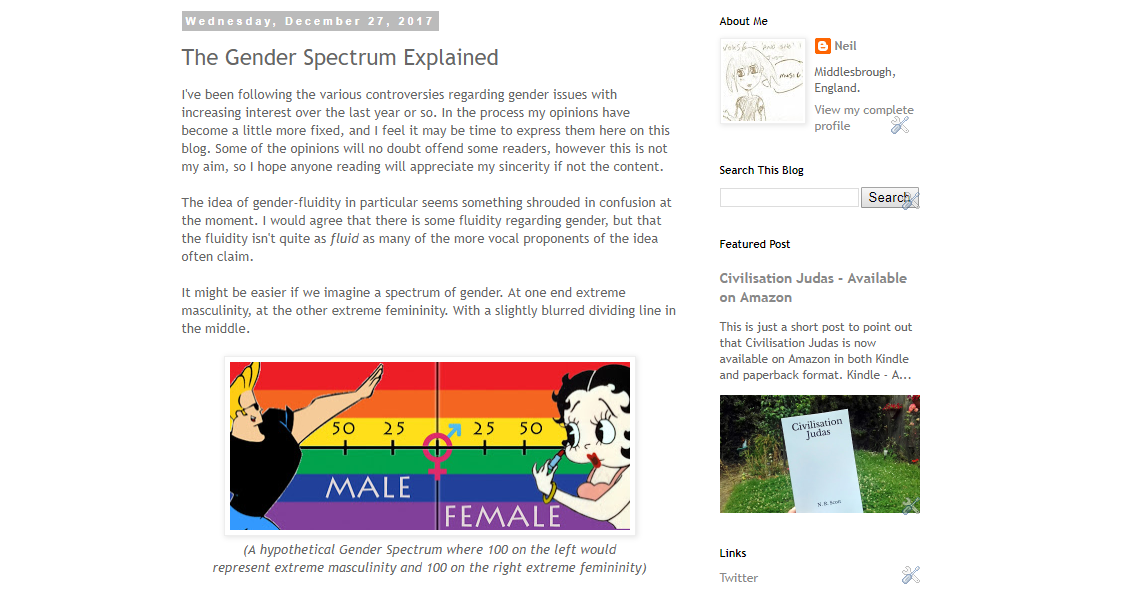
I won't go into my own views about the transgender issue here as I've written about this before. So it's easier to just direct anyone interested here -->> The Gender Spectrum Explained

(..._)

Monday, August 5, 2019

Take some time..

There's a natural taboo around death. If someone dies basic human decency implores us to show respect. To say nice, respectful things, or just show a dignified silence. To not speak ill of the dead, especially in the weeks and months following the death.

Even if we didn't like the person in life, or we think that they were a bad person we still show this respect. Partly out of respect to them, partly out of respect for human life in general, and partly out of respect for their family and friends. Who will be in a state of sadness and grief. That are trying to understand and come to terms with a huge loss in their life.

Now sadly some unscrupulous people may exploit death, and the social taboos surrounding it. Either by opportunistically capitalising on an actual death, or by simply concocting a death and exploiting the outpouring of sympathy. Like a conman who invents a tale of self-woe to con an old lady out of her life savings.

Of course, if you call out such a conman it's you that looks like the bad guy. Especially if the people being conned have emotionally invested in his tragic tale. "How could you say such a thing, this man lost his entire family in a freak boating accident."

Again, that natural taboo. In a normal decent society it would be heartless to question such a story, and decent people quite naturally see such a lack of respect for the recently deceased as something intuitively wrong. So if you do suspect that such a tale is false it's a tricky position to be in. You don't like to see your friends and family being conned, but social convention prevents you from speaking out. Plus of course your suspicions could be wrong, in which case you'd very much be the bad person.

So what am I really getting at here? As per the example, basic human decency forbids me from saying. However, what I would stress is that when changes are made to the way we live. Political changes, societal changes. We should always take the time to seriously think about the potential consequences of the changes we're proposing or supporting, and not just base our opinions on emotional "in the moment" responses.

When we make major changes to the laws that govern our societies we need to think about everyone in society, as well as the future generations that will follow us. So it's incumbent upon us all that when serious events occur. Events that make us reconsider our laws and mores. That we first allow a time to grieve. A period of respect for those directly affected. Then patiently and with due diligence proceed with the political response. Allowing for civilised debate, considered thought and time enough to contextualise fully the events that have occurred.

If we act in the heat of the moment. Perhaps based on faulty information, or even deliberately false information. Then that's how major mistakes are made and further problems caused.

Sunday, August 4, 2019

In the Month of Augustus

A little bit different today. On my other blog I sometimes point out that religions can be viewed as redundant political systems. Once upon a time, in an age before the separation of church and state, religions were the state. And religious law was the law. There was no clear separation. Our failure to recognise this often leads us to misunderstand the past.

Anyway, the case in point that struck me today comes in regard the calendar. Many of our months and days are named after gods and historical figures. Thursday and Friday named after Thor and Freya. The month we're in now, August, supposedly named for the Roman emperor Augustus. The previous month, July, likewise said to be named for Julius Caesar.

We often look back at our forebears with condescension when we see how they named such things after gods, or viewed mere men as gods - or possibly allowed themselves to be ruled by men who portrayed themselves as gods ..but perhaps we're misunderstanding the past. After all we have similar things now.

Lincoln's Day, Martin Luther King Jr. Day, Guy Fawkes Day, Columbus Day, and so forth.

All named for real world political figures or for important cultural/political events. Over time these events and figures have become somewhat larger than life, and the further back in time they occurred the more so they begin to blur into myth and legend. Perhaps one day, on seeing the "Lincoln Day" in the calendar, along with the various Lincoln statues we leave to posterity, future people may deem that we worshipped Abraham Lincoln in a similar way to the way the Romans were said to worship Caesar.

Of course, if they did this they'd be completely misunderstanding our culture and why we have these things.

(A very able looking statue of Abe Lincoln, flanked by Augustus
 - and you wonder how the rumours started)

On understanding this the logical thing to do is to reappraise our Roman forebears, give them a bit more credit, and recognise that such relics in our calendar perhaps arrived there because of similar social and political reasons. Rather than due to some vague religious fervour. Perhaps it was also at one time the same with the various "gods" representing the days of the week.

Over time the calendar has become more complex and precisely measured. So it would make sense that we first starting naming the months and the recurring week days. Only to then get more precise later as we developed the technology to more easily remember specific dates. Maybe Lincoln would've got a whole month had he arrived on the scene a few millennia earlier. (Jesus, the major figure in western historic tradition got the whole calendar started on his birthday (!) )

Today we tend to see ourselves as being much more advanced than these earlier cultures, and we believe that we've left a lot of their bad habits behind ..but are we really so different?

Take the inquisition and various other religious persecutions. Where people were persecuted as heretics for simply not believing. For not believing in Jesus Christ, or for not believing the correct version of Christianity. For not believing that a man died for our sins. Surely we wouldn't persecute people today for not believing that someone died? Or that a popular event in our culture wasn't quite as reported. Thank God we're past that, hmm..

It seems that by not believing you become a heretic. Again, we tend to think of these things in purely religious terms now, but like Lincoln's birthday or perhaps the month of July, they're very much political in nature. Heresy is not about belief, but about unbelief. If you stray from the "official" line then you become heterodox. It makes perfect sense. If you question those with power and refuse to fall in line then obviously they're not going to like that very much. It makes much more sense than priests and kings persecuting people for no other reason than religious pedantry.

Once again, we think we've left all this behind. That we're beyond all that backwards superstition and persecution, but the more savvy will see the parallels with the modern world only too well.

It could be said that in many ways the modern heretic is the conspiracy theorist. Again that unbelief thing. "What, you don't believe we went to the Moon? Are you saying all the governments and institutions are lying !! ?"

The conversation must have been similar in earlier times.

"What, you don't believe in the Trinity! Are you saying all the priests and kings are part of some vast conspiracy?"

I'm overdramatising a little, but you get the point. It's not that hard for "conspiracies" or untruths to take root in any society, including today's. Most people will believe anything, or at least pretend to believe anything, if it pays the rent or mortgage. As Winston Zeddemore says in Ghostbusters "..if there's a steady paycheck in it I'll believe anything you say." However, for those that refuse, or for those that reach a point where they simply can't believe nor pretend to believe no more, then they become heretics.

Saturday, August 3, 2019

Elections (lazy post)

Another shorty. I'm really just posting for the sake of it here. I'm determined to post everyday though. Can't let myself get too lazy.

The 50 Brexit Party candidates were revealed yesterday. No one for my area yet :( however, we do have a lady standing for Redcar, Jacqueline Cummins, which is just down the road from here. So things are beginning to move.

Also, I forgot to mention yesterday that the Lib Dems won the Brecon and Radnorshire by-election (I think that's in Wales). Looking at the percentage shares it seems the Lib Dems did very well indeed. Of course, the Conservative vote was split by the Brexit Party standing.

Liberal Democrat: 43.5%
Conservative: 39%
Brexit Party: 10.5%
Labour: 5.3%

The result wasn't too bad for the Conservatives in terms of illustrating their potential vote share should they fulfil Brexit. Labour clearly got trounced though.

Looking at the Lib Dem vote share it leads one to wonder how many of those were voting because of Brexit (remain voters), how many because of a genuine feel for the party in general, and how many just because they've lost faith in, or dislike Labour.

I get the feeling that the way things are heading every individual seat at any forthcoming general election will be a unique set of circumstances. Understanding the local terrain and having a good grass roots campaign could be key. The Lib Dems seem to be excelling in that area at the moment. I've criticised them in previous posts on here by they do seem to have momentum and a clear (or at least clearer) message.

I don't want to think too far ahead but if there continues to be animosity between the Brexit Party and the Conservatives things could get quite chaotic. Of course, this by-election means that there's one more remainer in parliament too now. Which makes a general election even more likely I guess. So it's interesting times.

(That wasn't too short was it actually. Shows that it's just a case of giving yourself that initial kick up the arse to get yourself started.)

Friday, August 2, 2019

Brexit Party GE Candidates

I'll keep it short this time. I ended up sat there til two in the morning with the last one. Plus the English football season is starting this weekend, so plenty of distractions.

Today the Brexit Party are announcing 50 of their potential GE candidates. So it'll be interesting to take a look at them. To see who they are and where they're standing. We should learn a lot. I wonder if they have someone lined up for my area??

I'm Bored Of The Irish Border

Almost forgot to post today. Was just gonna head off for bed, but it suddenly occurred that I hadn't had my daily whine. So a cup of coffee, some music and little bit of typing in the midnight hour for me.

Having been on Twitter at varying points today I get the feeling that things are fragmenting a little bit politically. I'm talking about the general public here. I think people are starting to get tired of the Brexit argument, from both sides. I don't know if this is a good thing or a bad thing, but I guess it was inevitable that the fizz would start to go. It always massively benefits the status quo whenever this happens. As change requires energy. So I fear for Brexit if Boris's heart (and his boundless energy) is not in it.

I can feel this jadedness myself. Today we've seen more fear regarding the potentiality of a "no deal", especially in regard Northern Ireland yet again. Before I would've been annoyed and ready to make the counter argument, but I haven't really felt the urge to do that today. Mainly through sheer boredom. I'm getting too bored to even argue now (!) There are only so many times you can explain the Irish border to someone.

  • That there already is a border. That they even use a different currency in the Republic of Ireland at present !
  • That we don't need checks at the border for businesses as it's their responsibility to act within the law. That if they get caught fiddling their taxes, or selling illegal products, or not following the law of the land - anywhere in the land - then they will be taken to court and prosecuted. Just like any business breaking the law anywhere else.
  • That when goods from a factory in the Republic of Ireland are taken to a shop in Northern Ireland all the paperwork is done by the respective companies, at their respective shops and factories. Not at some imaginary point on the journey.
  • That a hard border, with border checks at the border, is only required to stop serious criminal activity. Smuggling weapons, human trafficking, etc. That given the Republic of Ireland and Northern Ireland are both modern, civilised countries, that believe in the rule of law, they will obviously work together to tackle such illegal behaviour.
  • That any such checks can be as soft as random checks on the respective motorways or checks simply pulling over suspicious vehicles. Again, just as police would do anywhere else in the country.

So any talk of a hard border that would stop Irish people and businesses from carrying on exactly as normal is just blatant fear mongering. It's pretty irresponsible as well given the history.

I said I was getting bored making this argument, but I've somehow found the ire and energy to do it here it seems - even at this late hour 😄

It is quite infuriating though to see people looking for problems that aren't really there, and refusing to look at the nuts and bolts reality.

The way the doom-mongers conflate the Irish border and the border in the English Channel is particularly revealing and indicative of their lack of basic common sense too.

Obviously when things come into the country by a sea port there have to be checks. As a ship journey ends, and a land journey begins. So goods need to be unloaded from a ship and then loaded onto a lorry or some other vehicle. So you have to check to make sure you know what's coming off the ship or going onto the lorry, or vice versa.

Because of these checks at the ports - be they extra checks, or just different checks - then yes, there could be some temporary slow down at these borders. It would only be temporary though, as the change is adapted to, and it isn't really a huge thing to worry about. Certainly not to the extent of the panic reporting we've been subjected to. Of course, in reality, as everyone who's worked in the real world knows, sometimes checks can be rushed through or completely ignored anyway if things are running way behind schedule. So even if there were delays they could be dealt with pretty quickly I would wager.

I'm not sure how seriously regulations are taken at the ports - I would guess much more strictly than the places I've worked (: However, we are just talking about basic goods for the most part here. If a company pays for 40,000 tins of beans but only receives 38,000 on the delivery it's bad for business, but hardly a national security issue. Plus it must be noted, all the doom-mongers and remainers getting their heads in a tizz over border checks seem rather blase about the countless illegal migrants that are turning up in the backs of lorries every day as it stands. I really don't know how they have the nerve to complain about the potential state of a post-Brexit border when the borders are in absolute chaos already.

At the Irish border there's obviously no need for such checks though. It's not like goods are unloaded from one vehicle and then put into another at the border. It's just one long journey from factory to warehouse, or warehouse to shop. This is just basic common sense. It shouldn't need pointing out really. Although to be fair these things, even though they're simple, practical things, only really become obvious once you begin to think about it all. When you actually imagine (or experience in real life) the process of moving goods from one place to another.

Remainers just seem to refuse to think about it altogether though, and continue to conflate all these small practical issues into one huge calamity. Blurring all borders into one big imaginary one.

It's a bit like dealing with a friend or family member that doesn't want to do something, but won't admit it. Instead of just saying they don't want to go to the cinema they pretend they want to but make excuses..


"..but what if the film we want to see isn't on?"

"Don't worry, no problem, I'll phone up and find out."

"..yeah, but it's going to rain, we'll get soaked."

"No worries, I'll get a brolly."

"...but, but, but.."


It's a bit like that. Any excuse to drag their feet.


Finally, regarding the idea of a hard border on the "island of Ireland" as they say. The very idea that the EU would do this or insist upon it is particularly insulting to the UK and Northern Ireland. Just look at how poorly maintained the entire external border of the EU has been over the last decade or so. It's so porous as to be non-existent. The idea that they would go to such trouble and get so uppity about border problems in Ireland, while at the same time taking their real, wider border issues so unseriously just illustrates a complete lack of goodwill on their part.

I keep hoping, given the reality of the situation at present, that the EU will start listening to people and reform, but it's just not happened. Quite the opposite in fact. We're seeing a bigger push for further integration.

Why not be more flexible with Britain either within or outside the EU?

The fact that it will neither offer Britain the option to reform things from within, or to have good, friendly relations without, shows that we are dealing with sheer idealism here. An idealism that leaves no room for alternative opinions, and that puts ideology ahead of reality and compromise.

I really wish they'd all just chill out a bit.